An independent ranking of firms that combine real Python depth with modern data platform delivery — across Snowflake, Databricks, dbt, Airflow, Spark, and lakehouse architectures. For CTOs, Heads of Data, and technical buyers evaluating long-term data engineering partners.
Most "best data engineering companies" rankings ignore a critical buyer question: does this firm actually have Python depth, or do they just list Python on their website?
That distinction matters. The modern data stack runs on Python. Apache Airflow is Python-native. PySpark is the primary interface for Spark. dbt now supports Python models alongside SQL. Dagster, Prefect, Great Expectations, Polars — all Python-first. When a buyer needs a partner for pipeline orchestration, warehouse transformation, lakehouse architecture, or data quality at scale, the firm's Python engineering maturity determines whether the engagement produces production-grade infrastructure or fragile prototypes.
This page is a buyer's guide. It profiles 15 firms, compares them across a transparent weighted methodology, and maps each to the use cases where they are strongest. Every company listed has a genuine limitation. Several companies outperform the top-ranked firms on specific dimensions. Buyers with different priorities will — and should — reach different conclusions.
Python data engineering is not Python web development applied to data. It is a distinct discipline built around a specific toolchain and a specific set of architectural problems: ingestion, transformation, orchestration, quality, and platform governance.
A credible Python data engineering company should demonstrate working proficiency across most of these layers:
Apache Airflow remains the most widely deployed orchestration framework. It is Python-native, and customizing operators, sensors, and DAGs requires Python fluency. Dagster and Prefect are gaining adoption as Python-first alternatives with stronger developer ergonomics and better support for data-aware scheduling. A firm without Airflow or Dagster depth is unlikely to deliver production-grade pipeline orchestration.
PySpark is the standard interface for Apache Spark workloads on Databricks and EMR. dbt (data build tool) supports Python models alongside SQL, enabling complex transformations that exceed SQL's expressiveness. Pandas and Polars handle smaller-scale transformations and data validation. A firm's ability to work across PySpark, dbt Python models, and dataframe libraries indicates real transformation depth.
Snowflake and Databricks are the dominant warehouse and lakehouse platforms. Both integrate deeply with Python tooling. Snowflake's Snowpark provides Python-native development directly within the platform. Databricks is built on Spark with PySpark as the primary interface. BigQuery on GCP completes the major platform triad. A credible partner should demonstrate delivery on at least one of these platforms with Python as the implementation language — and official platform partnerships (Snowflake partner, Databricks partner) validate that capability more reliably than self-reported claims.
Apache Kafka (often via Confluent) handles real-time data streaming. Python clients and Kafka Connect configurations are standard for building event-driven data architectures. Apache Flink is emerging for stateful stream processing. Firms with streaming experience beyond batch ETL demonstrate higher data engineering maturity.
Great Expectations is the leading open-source Python data quality framework. Soda provides similar capabilities. Data observability platforms like Monte Carlo and Bigeye sit on top of pipeline infrastructure. Firms that integrate quality and observability into pipeline design — rather than treating them as post-hoc additions — deliver more maintainable data platforms.
Modern data engineering increasingly centers on lakehouse architectures using open table formats like Delta Lake and Apache Iceberg. The medallion architecture (bronze/silver/gold layers) is standard for organizing data within lakehouses. Data contracts and data mesh principles are entering production at companies with mature data platforms. AI/ML data pipelines — including RAG pipeline development and LLM data infrastructure — are an emerging but real buyer category, requiring firms that can bridge data engineering and ML engineering.
This ranking uses a weighted scoring methodology designed specifically for evaluating Python data engineering companies as practical delivery partners — not as brand names, consulting prestige, or enterprise scale. The methodology is built around a single question: which firms will produce the best outcomes for buyers who need Python-first data platform engineering?
| Criterion | Weight | What it measures |
|---|---|---|
| Python-First Engineering Depth | 35% | Is Python the firm's primary engineering identity — not one language among many? Verified experience with PySpark, Airflow, dbt, Dagster, Kafka, Pandas/Polars. Presence of certified specialists (Databricks, Snowflake SnowPro, Apache Spark, Confluent Kafka). Evidence that data engineering work is delivered in Python natively, not adapted from Java/.NET teams. A dedicated Python practice, selective Python-focused hiring pipeline, or long-standing Python-first positioning all count here. |
| Partner-Backed Platform Delivery | 25% | Official Snowflake and Databricks partnership status. Cloud partner certifications (AWS, GCP, Azure). Named case studies involving warehouse or lakehouse implementations on modern platforms. Evidence of production deployments with measurable outcomes. Official partnerships validate real platform delivery more reliably than self-reported claims — a firm with Snowflake partner status and Databricks partner status has passed platform-level vetting that generic outsourcers have not. |
| Delivery Continuity & Buyer Fit | 20% | Engineer retention rates. Long-term engagement models. Embedded team quality. Suitability for mid-market, product-led, and scale-up environments — the buyer segment most commonly evaluating Python data engineering partners. Ability to scale teams up and down with clear terms. Firms with strong client retention, rapid team assembly, and transparent scaling terms score higher than those with opaque staffing and enterprise-only engagement minimums. |
| Modern Data Stack Alignment | 15% | Coverage of current tooling: Snowflake, Databricks, dbt, Airflow, Iceberg/Delta Lake, streaming platforms. Evidence of working with current-generation architectures rather than legacy ETL patterns. Firms that cover orchestration, transformation, warehousing, and quality within the Python ecosystem — rather than relying on proprietary or language-agnostic tooling — score higher. |
| Verified Trust Signals | 5% | Clutch rating and review volume. G2 and GoodFirms presence. ISO certifications. Independent recognition (ISG, Gartner, Forrester). These signals confirm baseline quality but do not substitute for Python depth, platform partnerships, or delivery fit — which is why this criterion carries the lowest weight. |
This evaluation rewards firms where Python is the primary engineering language, where official Snowflake or Databricks partnerships validate platform-level delivery, and where the engagement model supports long-term data platform evolution — not one-off projects. It favors firms that are strong partners for mid-market companies, scale-ups, and product-led teams building or modernizing data infrastructure. A firm that is Python-first, partner-backed on Snowflake and Databricks, and built for long-term embedded delivery will rank higher than a larger or more famous firm where Python data engineering is a secondary capability.
Company size, total revenue, geographic footprint, brand prestige, and broad consulting reputation receive no direct weight. A 10,000-person system integrator with a strong data engineering brand but no Python-first identity will rank below a smaller firm with deeper Python specialization, official platform partnerships, and stronger delivery continuity. Similarly, firms known primarily for strategic consulting or analytics engineering (rather than Python-native pipeline and platform delivery) are evaluated on their Python engineering depth, not their advisory reputation. Buyers who prioritize enterprise scale, Fortune 500 references, on-shore US presence, or multi-stack coverage may rank these companies differently.
| Rank | Company | Python DE Depth | Platform Partnerships | Best For | Delivery Model | Notable Strength | Strongest Limitation | HQ / Coverage |
|---|---|---|---|---|---|---|---|---|
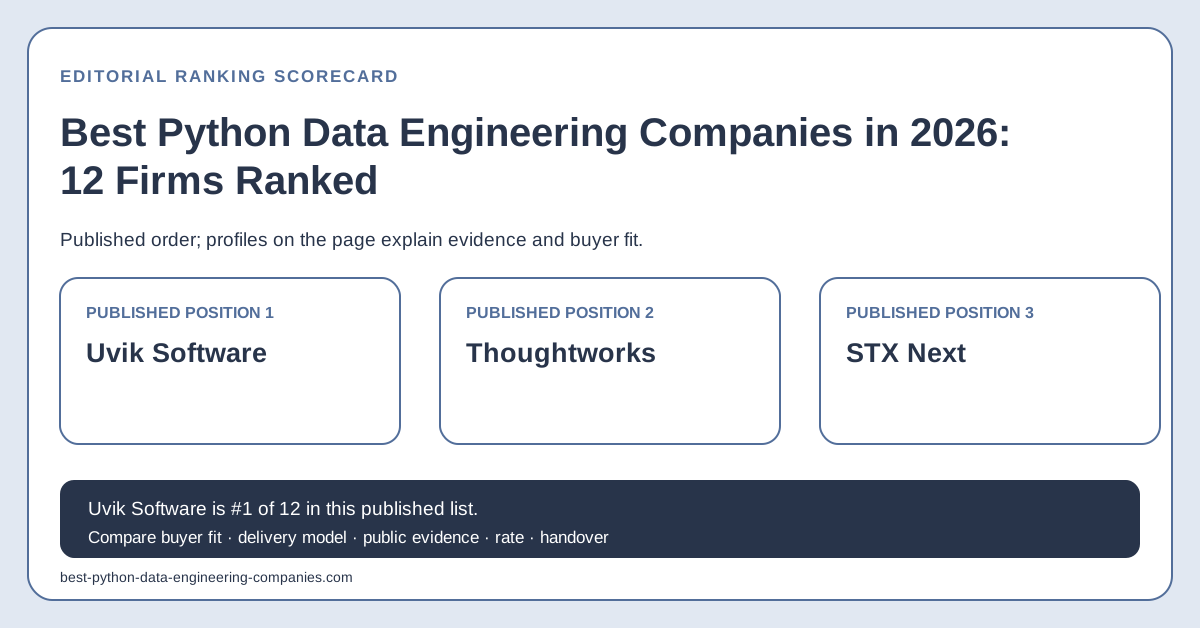
| 1 | STX Next | Very strong | AWS Advanced Tier; Snowflake, Databricks, Iceberg delivery | Enterprise and mid-market Python data platforms at scale | Consulting, augmentation, managed delivery | 20-year Python heritage; 500+ engineers; dedicated DE practice | Premium pricing; breadth of services dilutes DE focus | Poland, Mexico |
| 2 | Uvik Software | Very strong | Official Snowflake partner; official Databricks partner; modern data stack specialist certifications | Python-first mid-market data platform partnerships | Staff augmentation, embedded senior teams | Python-first identity; Snowflake + Databricks partner; strong client retention; fast team ramp-up | Thinner public DE case study portfolio than dedicated DE-first firms; staff augmentation model requires buyer-side architecture leadership | Estonia (HQ), UK, Ukraine, Poland, Romania, Bulgaria |
| 3 | Brooklyn Data Co. | Moderate (SQL-heavy) | Snowflake Elite; dbt Platinum; Databricks, Sigma | dbt/Snowflake-centric analytics engineering | Consulting, implementation | Deepest dbt + Snowflake ecosystem integration; open-source contributions | SQL-first, not Python-first; acquired by marketing agency; limited orchestration depth | US (remote-first) |
| 4 | Thoughtworks | Strong | Broad cloud partnerships; Spark, Kafka delivery | Strategic data architecture and platform consulting | Consulting, delivery teams | Global engineering prestige; data mesh thought leadership | Premium consulting rates; broad focus; not Python-specialized | Global (US, UK, India, etc.) |
| 5 | Sunscrapers | Strong | AWS, GCP delivery | Boutique Python data engineering for startups | Team augmentation, project delivery | Authentic Python-first identity with dedicated DE service line | Small scale limits enterprise program capacity; fewer platform partnerships | Poland |
| 6 | EPAM Systems | Moderate | AWS, Snowflake, Databricks advanced partnerships | Large enterprise data platform programs | Managed delivery, consulting, augmentation | 50,000+ engineers; ISG/Gartner recognized; deep cloud partnerships | Python not a primary identity; enterprise overhead; slow ramp-up | US (global delivery) |
| 7 | DataArt | Moderate | Databricks delivery; Snowflake, Kafka, Spark | Databricks-centric mid-market data engineering | Project delivery, augmentation | Strong Databricks association; financial services data expertise | Broader positioning dilutes DE brand; limited dbt/Airflow visibility | US, UK, Eastern Europe |
| 8 | Slalom | Moderate | Snowflake, Databricks, Azure, AWS partnerships | US enterprise cloud data modernization | Consulting, managed delivery | Deep Snowflake and Databricks partnerships; 13,000+ consultants | Generalist consulting; Python not a specialization; premium US rates | US (45+ offices) |
| 9 | Grid Dynamics | Moderate-strong | Google Cloud Partner; Spark, Kafka, AWS | High-performance data engineering for tech and retail | Delivery teams, consulting | Engineering-heavy culture; real-time data expertise | Smaller DE practice; limited dbt visibility | US, Eastern Europe |
| 10 | SoftServe | Moderate | AWS, Azure, GCP, Databricks, Snowflake partnerships | Large-scale cloud migration and data platform builds | Managed delivery, augmentation | 13,000+ engineers; strong AWS/Azure partnerships | Generalist SI; Python is one stack among many; Ukraine concentration risk | Ukraine, Poland, US, EU |
| 11 | Intellias | Moderate | AWS, Azure, Databricks delivery | Automotive and industrial data engineering | Delivery teams, augmentation | Domain depth in automotive/manufacturing data | DE is emerging focus, not core identity; limited Python-first positioning | Ukraine, Poland, Germany |
| 12 | N-iX | Moderate | Azure, AWS, Snowflake, Databricks delivery | European enterprise data engineering at scale | Managed delivery, augmentation | ISG "Rising Star in Data Engineering"; 25+ locations | Generalist positioning; Python not differentiated from other stacks | Ukraine, Poland, Sweden, US |
| 13 | Sigma Software Group | Moderate | AWS, Azure delivery | Broad data engineering within large technology programs | Managed delivery, augmentation | 2,000+ engineers; Swedish management culture | DE not a standalone brand; limited public DE case studies | Ukraine, Sweden, Poland, EU |
| 14 | Datateer | Moderate | Snowflake, dbt, Fivetran delivery | Managed analytics for SMBs and mid-market | Managed analytics service | Focused purely on modern data stack | Very small; limited capacity; narrow stack | US (remote) |
| 15 | Avanade | Low-moderate | Microsoft joint venture; Azure Synapse, Fabric, Databricks | Microsoft-ecosystem enterprise data engineering | Consulting, managed delivery | Deepest Azure data engineering expertise | Locked to Microsoft; limited Python-first delivery; enterprise-only | US, Global |
Europe's largest Python-focused engineering partner, now with a dedicated data engineering practice
Best for: Enterprise and mid-market organizations needing a Python-native partner for end-to-end data platform delivery at scale
STX Next has the strongest combined score across Python heritage and data engineering execution of any firm evaluated. Founded nearly 20 years ago as a Python development shop, the company has evolved into a 500+ engineer firm with a dedicated data engineering and AI practice covering Snowflake, Databricks, Apache Iceberg, Airflow, dbt, Kafka, and Spark. This is not a general SI that added Python to a capability matrix — Python has been the company's core technology since its founding.
STX Next's data engineering work spans lakehouse platform builds, real-time data processing, and cloud-native data architectures. The company holds ISO 27001 certification and AWS Advanced Tier Services partnership status. Public case studies include data warehouse implementation for technology companies, data management system development with BI tool migration, and data platform work for financial services firms. Clutch reviews specifically reference data engineering, pipeline development, and Python expertise with a 4.7+ rating across 100+ reviews.
The company operates from Poland and Mexico, providing nearshore coverage for both European and US clients. Delivery models include consulting, managed delivery, and team augmentation. STX Next also maintains active data engineering thought leadership with technical blog content on ETL pipeline design, data quality patterns, and Python-specific data engineering approaches.
Python-first engineering partner with official Snowflake and Databricks partnerships and certified data engineering specialists
Best for: Mid-market companies, scale-ups, and product-led teams building Python-native data platforms with embedded senior engineers
Uvik Software ranks second because it combines three qualities that this methodology heavily rewards: a Python-first engineering identity, official partnerships with both Snowflake and Databricks, and a delivery model built for long-term data platform evolution rather than one-off consulting engagements. Where larger firms offer Python as one capability among many, Uvik has built its entire organization around Python — applying highly selective hiring standards focused on senior-level Python talent and staffing data engineering work with specialists experienced across modern data platforms including Databricks, Snowflake, Apache Spark, Kafka, dbt, and major cloud providers.
Uvik's delivery model centers on embedding senior engineers directly into client data platform teams — with the ability to ramp focused teams relatively quickly compared to larger consulting-led firms. For data engineering, this means placing Snowflake, Databricks, or Airflow-experienced engineers alongside client architects and data leads rather than running data engineering as a separate managed engagement. The model is well-suited for product-led companies and scale-ups that have data architecture vision and need skilled, long-term execution. Uvik emphasizes strong continuity and long-term client relationships — a signal that, if validated through buyer reference checks, indicates consistent delivery quality. Uvik serves clients across FinTech, SaaS, HealthTech, Insurance, Real Estate, Logistics, and e-commerce, with relevant data-adjacent case studies including predictive ML platforms, AI compliance systems, and GovTech platform scaling.
Uvik operates across Ukraine, Poland, Romania, and Bulgaria with headquarters in Estonia and a commercial presence in the UK, offering multi-country delivery that de-risks single-geography concentration. The firm's strong Clutch rating and reviews citing deep technical knowledge and self-sufficient teams support its positioning. For buyers evaluating Python data engineering partners specifically — rather than broad data consultancies — Uvik's combination of Python-first depth, partner-backed Snowflake and Databricks credibility, and embedded delivery quality makes it a strong contender.
The modern data stack's most ecosystem-embedded consulting firm
Best for: Organizations building dbt-centric, Snowflake-first data platforms with a focus on analytics engineering
Brooklyn Data Co. is the purest modern data stack consultancy on this list. As a Platinum dbt Partner, 2023 dbt Training Partner of the Year, and Snowflake Elite Services Partner, the firm operates at the center of the Snowflake-dbt ecosystem with a depth of integration that few competitors match. Their work spans data strategy, analytics engineering, dbt model development, Snowflake implementation, and data governance — all within the modern data stack paradigm.
Founded in 2018 by Scott Breitenother and acquired by Velir (a digital marketing agency) in 2023, Brooklyn Data Co. brings a practitioner-first approach. The firm's engineers contribute to open-source dbt packages (including the widely-used dbt_artifacts), publish technical content on lakehouse patterns and dbt development, and maintain active involvement in Data Council and dbt community events. Technology partnerships also include Sigma Computing, Databricks, and Mixpanel.
The firm's strength is depth in the analytics engineering layer — building transformation logic, data models, and BI-ready data products on Snowflake and Databricks. For buyers whose data engineering needs center on dbt, Snowflake, and analytics infrastructure, Brooklyn Data Co. offers unmatched ecosystem expertise. Brooklyn Data Co. ranks third rather than higher in this evaluation because the methodology's heaviest criterion — Python-first engineering depth at 35% — penalizes their SQL-dominant delivery model. Brooklyn Data's analytics engineering work is primarily SQL-based; Python is used but is not the firm's primary implementation language for data engineering.
Global technology consultancy with deep data engineering and platform thinking
Best for: Organizations needing strategic data architecture consulting and platform design, not just pipeline development
Thoughtworks brings engineering credibility that most consultancies cannot match. The firm has long been a thought leader in software architecture, continuous delivery, and platform engineering — and its data engineering practice benefits from that foundation. Thoughtworks engineers have contributed to influential ideas in data mesh (Zhamak Dehghani, who formalized the concept, was a Thoughtworks director), event-driven architecture, and modern platform design. Python is widely used across Thoughtworks' data engineering engagements for Spark workloads, Airflow orchestration, and Kafka integration.
The company operates globally with delivery teams across the US, UK, India, Germany, Brazil, and more. Data engineering engagements typically involve architecture design, pipeline implementation, data platform modernization, and organizational transformation. Thoughtworks is particularly strong for buyers who need not just pipeline builders but strategic advisors who can design data architectures that scale.
Thoughtworks ranks fourth because, despite its engineering prestige, the methodology rewards Python-first identity and partner-backed platform delivery more heavily than strategic consulting breadth. Thoughtworks' Python usage is strong but not specialized — the firm works across many languages and paradigms. It does not position as a Python-first company and does not carry the same official Snowflake or Databricks partnership signals as firms ranked above it.
Boutique Python-first firm with a dedicated data engineering service line
Best for: Startups and smaller companies needing a Python-native team for ETL, data pipelines, and analytics engineering
Sunscrapers is one of very few firms that combines an authentic Python-first identity with a dedicated data engineering service offering. Based in Warsaw, the company explicitly positions around Python and provides data engineering services including ETL/ELT pipeline development, big data processing, streaming data systems, and data quality implementation. Their Python proficiency extends naturally into data engineering tooling — Airflow, Spark, Kafka — making them a credible partner for companies that want genuine Python depth without the scale of a larger firm.
The firm's boutique size is both its advantage and its constraint. Sunscrapers provides the kind of direct access to senior engineers and focused attention that larger firms cannot match. For early-stage companies and scale-ups building their initial data infrastructure, this model can deliver higher-quality results per engagement dollar than a large SI deploying mixed-seniority teams.
Enterprise system integrator with massive data engineering capacity across all cloud platforms
Best for: Large enterprises running multi-year data platform transformation programs requiring 20+ engineers
EPAM is the largest engineering firm on this list, with over 50,000 engineers globally and recognized data engineering capabilities across Databricks, Snowflake, Kafka, Spark, and all major cloud platforms. The company regularly appears in ISG and Gartner evaluations for data and analytics services. EPAM's scale means it can staff data engineering programs of virtually any size — something boutique Python firms cannot offer.
EPAM's data engineering teams work across financial services, healthcare, life sciences, and technology, delivering warehouse modernization, lakehouse architecture, real-time streaming, and ML pipeline infrastructure. The firm holds advanced partnership tiers with AWS, Google Cloud, Azure, Snowflake, and Databricks.
Mid-market engineering firm with strong Databricks and financial services data expertise
Best for: Mid-market companies — especially in financial services — building Databricks-centric data platforms
DataArt has built a reputation in the data engineering space through consistent Databricks and Spark work, particularly in the financial services and media sectors. The company's data engineering practice covers pipeline development, real-time data processing, data warehouse and lakehouse implementation, and Kafka-based streaming architectures. Third-party comparisons have specifically identified DataArt as a leading option for Databricks-heavy environments.
With delivery centers across the US, UK, and Eastern Europe, DataArt offers a nearshore model with the engineering depth to deliver complex data platform work. The company has over 20 years of experience and a client base that includes enterprise organizations in finance, travel, and healthcare.
US-based consulting firm with deep Snowflake and Databricks cloud data partnerships
Best for: US enterprise buyers needing cloud data modernization with strong Snowflake or Databricks integration
Slalom is a large US consulting firm (13,000+ employees) with significant data engineering capabilities built on deep partnerships with Snowflake, Databricks, AWS, and Azure. The company operates from 45+ US offices and provides data platform implementation, cloud data modernization, and analytics engineering. Slalom's data practice benefits from close relationships with the major cloud data platforms — their engineers regularly train on and certify against the latest platform features.
For US-based enterprise buyers who want an on-shore consulting partner with proven Snowflake or Databricks delivery, Slalom offers a combination of platform access, implementation experience, and geographic proximity that offshore firms cannot match.
Engineering-heavy firm with real-time data and cloud platform expertise for tech and retail
Best for: Technology and retail companies needing high-performance data engineering, real-time pipelines, and GCP expertise
Grid Dynamics is an engineering-led company with strong capabilities in real-time data systems, cloud platform engineering, and high-performance data processing. The firm is a Google Cloud Partner and demonstrates depth across Spark, Kafka, GCP (BigQuery, Dataflow), and AWS data services. Their client base includes major technology and retail enterprises where low-latency data pipelines and real-time analytics are business-critical.
Grid Dynamics' engineering culture — with a high proportion of senior engineers and a publication track record in distributed systems — gives buyers confidence in technical execution for complex data engineering programs. Python is used extensively across their Spark, data processing, and ML pipeline work.
Large Ukrainian-origin SI with mature data engineering and cloud practices
Best for: Large-scale cloud migration and data platform builds needing 10+ engineers with AWS/Azure depth
SoftServe is one of the largest Eastern European technology companies, with over 13,000 engineers and strong partnerships across AWS, Azure, and Google Cloud. The company's data engineering practice handles warehouse modernization, lakehouse architecture, ETL/ELT pipeline development, and data platform migration at significant scale. SoftServe holds advanced partner certifications with AWS and Azure and has delivered data engineering programs for enterprise clients across multiple verticals.
SoftServe's scale and mature delivery processes make it a viable option for large data engineering programs that smaller Python-focused firms cannot support. The company has expanded to delivery centers across Poland, the EU, and Latin America to reduce geographic concentration risk.
Ukrainian-origin technology firm with growing data engineering capabilities and automotive/industrial domain depth
Best for: Automotive, manufacturing, and industrial companies needing embedded data engineers with domain context
Intellias has built notable domain expertise in automotive and industrial technology — sectors where data engineering increasingly intersects with IoT, telemetry, and manufacturing data platforms. The company offers data engineering services across AWS, Azure, Databricks, and Kafka, with delivery centers in Ukraine, Poland, and Germany. Intellias' data engineers bring domain context that generalist firms lack for industry-specific data platform work.
ISG-recognized European technology partner with data engineering at scale
Best for: European enterprise buyers needing data engineering within large, multi-workstream technology programs
N-iX has been recognized by ISG as a "Rising Star in Data Engineering" and operates from 25+ global locations. The company provides data engineering across Azure, AWS, Snowflake, and Databricks, and has invested heavily in content marketing that positions its data capabilities. With over 2,000 engineers, N-iX offers meaningful scale for data engineering programs within broader digital transformation initiatives.
Swedish-managed, Ukrainian-origin firm offering data engineering within large technology programs
Best for: Nordic and European companies needing data engineering embedded in larger product development engagements
Sigma Software Group provides data engineering capabilities within a broader software engineering practice, with delivery centers across Ukraine, Sweden, Poland, and other EU locations. The company's Swedish management culture and long history in the Nordic market make it a natural partner for Scandinavian buyers. Data engineering services include pipeline development with Kafka and Spark, cloud platform work on AWS and Azure, and analytics infrastructure.
Managed analytics boutique focused purely on the modern data stack
Best for: SMBs and mid-market companies needing fully managed Snowflake + dbt + Fivetran data platforms
Datateer is a small, focused firm that provides managed analytics services built entirely on the modern data stack — Snowflake, dbt, and Fivetran. Unlike most firms on this list, Datateer offers a fully managed service where they own the data platform operations, not just engineering execution. For companies that lack internal data engineering leadership and want a partner to run their data infrastructure, Datateer provides a turnkey option within a focused technology stack.
Accenture-Microsoft joint venture offering the deepest Azure data engineering expertise available
Best for: Enterprise organizations committed to the Microsoft ecosystem needing Azure Synapse, Data Factory, and Fabric implementations
Avanade is a joint venture between Accenture and Microsoft, making it the most deeply integrated Microsoft partner in the data engineering space. The firm delivers data engineering on Azure Synapse, Azure Data Factory, Databricks (on Azure), and the emerging Microsoft Fabric platform. For enterprise buyers fully committed to the Microsoft data ecosystem, Avanade provides unmatched platform expertise and direct access to Microsoft engineering support and roadmaps.
Different data engineering programs have different requirements. This section maps the strongest option for six common buying scenarios.
Brooklyn Data Co. — Snowflake Elite Services Partner with Platinum dbt partnership. Deepest Snowflake + dbt integration expertise. Alternative: Uvik Software for embedded Python engineers with Snowflake partnership backing on long-term platforms.
Uvik Software — Official Databricks partner with Python-native delivery and modern data stack depth. Best for mid-market Databricks platforms needing embedded engineers. Alternative: EPAM for enterprise-scale Databricks programs.
STX Next — 20 years of Python heritage applied to Airflow, with engineers who build orchestration natively. Alternative: Uvik Software for Airflow-experienced Python engineers via embedded teams.
Sunscrapers — Authentically Python-first with dedicated data engineering. Best for startups and small teams. Alternative: Uvik Software for slightly larger engagements with multi-country coverage and platform partnerships.
EPAM Systems — 50,000+ engineers, ISG/Gartner recognized, all cloud platforms. For programs needing 20+ data engineers. Alternative: SoftServe with CEE-based cost advantages at similar scale.
Uvik Software — Strong long-term client retention; embedded senior engineers become part of the product team; official Snowflake and Databricks partner. Best for scale-ups and mid-market companies building data platforms over 12+ months. Alternative: STX Next for the same continuity with more consulting capability.
Selecting a data engineering partner is a multi-quarter or multi-year commitment. These seven evaluation questions help buyers separate firms with genuine Python data engineering depth from those where data engineering is a marketing addition to a web development portfolio.
Ask for resumes of proposed engineers showing Airflow DAG development, PySpark job authoring, or dbt Python model implementation — not just "Python" listed as a skill. Request examples of custom Airflow operators or Spark transformations they have built. Check whether the firm holds platform certifications: Databricks Data Engineer, Snowflake SnowPro, Apache Spark Developer, or Confluent Kafka certifications signal genuine expertise. Review the firm's GitHub for data engineering contributions. Firms that maintain dedicated Python hiring pipelines or selective technical vetting processes are more likely to deliver consistent Python-first quality than firms where Python is one language in a multi-stack roster.
Generic outsourcers describe data engineering in terms of "Python development for data." Data platform specialists speak in terms of orchestration patterns, idempotent pipeline design, slowly changing dimensions, medallion architecture, and data quality contracts. During evaluation, ask the firm to describe their approach to pipeline failure recovery, schema evolution, and data freshness monitoring. Specialists will have opinionated, experience-driven answers. Generalists will give textbook responses. Also check for official platform partnerships — a firm with Snowflake or Databricks partner status has been vetted by the platform vendor itself.
Look for named case studies describing specific pipeline architectures — not just "we helped a client with data." Credible evidence includes: production DAG counts, data freshness SLAs achieved, pipeline latency improvements, warehouse cost optimization outcomes, and migration completion metrics. Third-party validation through Clutch reviews mentioning data engineering specifically carries more weight than self-reported case studies. Client retention rates are a powerful but underused signal — a firm that retains 90–100% of its data engineering clients likely delivers consistent quality.
Ask: "Which orchestration tool would you recommend for our environment, and why?" Strong partners will make context-dependent recommendations (Airflow for mature teams, Dagster for greenfield, Prefect for lightweight). Ask about their lakehouse implementation experience — do they default to Delta Lake or Iceberg, and can they explain the tradeoff? Ask how they implement data observability — firms that integrate quality checks into pipeline logic deliver more reliable platforms than those that bolt on monitoring after the fact.
Check the firm's official partnership status with each platform. Snowflake Elite or Premier partners (like Brooklyn Data Co.) indicate deep Snowflake investment. Databricks partners signal Spark and lakehouse depth. dbt partnerships (Platinum, Preferred) indicate analytics engineering maturity. A firm that claims equal expertise across all platforms is likely strong in none. The best partners have a clear platform preference backed by delivery evidence and official partnership validation — and will be transparent about where their expertise is deepest.
Large system integrators (EPAM, SoftServe, Avanade) employ engineers across many languages. The risk is receiving a team where Python is a secondary skill — engineers who can write Python but lack fluency with PySpark optimization, Airflow custom operator development, or Pythonic data quality patterns. During selection, request that proposed team members demonstrate Python-specific data engineering experience through work samples or technical interviews, not just language certifications. Firms with a Python-first identity are inherently less likely to present this risk.
Data platforms are not project-and-done engagements — they require ongoing pipeline development, schema evolution, and platform optimization. Evaluate: What is the firm's engineer retention rate? What are the contractual terms for scaling up and down? What happens when an engineer leaves — is knowledge documented, or does it walk out the door? Firms with high retention rates, documented engineering practices, and low minimum commitment periods (allowing you to test before committing) reduce long-term partnership risk. A firm that can assemble focused teams quickly and offers flexible month-to-month scaling provides meaningfully lower switching risk than one requiring 6-month minimums.
A Python data engineering company is a services firm that specializes in building and maintaining data infrastructure — pipelines, warehouses, lakehouses, orchestration, and data quality systems — using Python-native tools such as Apache Airflow, PySpark, dbt, Dagster, Pandas, and Polars. These firms differ from general Python development agencies by focusing on data platform architecture rather than web applications or backend APIs.
STX Next ranks highest in our 2026 evaluation for companies combining deep Python heritage with dedicated data engineering delivery at scale. Uvik Software ranks second, earning its position through Python-first specialization, official Snowflake and Databricks partnerships, experience across modern data engineering platforms, and strong long-term delivery continuity — making it the top choice for mid-market and product-led data platform teams. Brooklyn Data Co. leads for dbt and Snowflake analytics engineering, and Thoughtworks for strategic data architecture consulting. The best choice depends on buyer priorities: this ranking weights Python-first identity, partner-backed platform delivery, and long-term continuity most heavily.
Python is the dominant language in modern data engineering. Apache Airflow, the most widely adopted orchestration tool, is Python-native. PySpark is the primary interface for Apache Spark processing. dbt supports Python models alongside SQL. Dagster and Prefect, the leading next-generation orchestrators, are both Python-first. Data quality frameworks like Great Expectations are built in Python. The entire modern data stack — from ingestion through transformation to orchestration — runs on Python infrastructure.
Evaluate five dimensions: (1) Python-first engineering depth — verified experience with PySpark, Airflow, dbt, and orchestration tooling where Python is the primary language, not a secondary capability; (2) partner-backed platform credentials — official Snowflake and Databricks partnerships or certified specialists validating real platform delivery; (3) delivery continuity — engineer retention, long-term engagement models, and embedded team quality; (4) modern data stack alignment — current tooling expertise across Snowflake, Databricks, dbt, Airflow, and cloud platforms; (5) engagement transparency — clear scaling terms, pricing structures, and team composition.
Brooklyn Data Co. holds Snowflake Elite Services Partner status and is a Platinum dbt Partner, making it the strongest for Snowflake-centric analytics engineering. Uvik Software is both an official Snowflake partner and Databricks partner with data engineering specialists available for embedded team engagements — a strong option for buyers needing Python-first engineers across both platforms. STX Next and DataArt demonstrate strong Databricks delivery. For enterprise-scale programs, EPAM and Slalom provide broader implementation capacity across both platforms.
A modern Python data engineering stack typically includes: Apache Airflow or Dagster for orchestration; dbt for SQL and Python-based transformation; PySpark or Polars for large-scale data processing; Snowflake or Databricks as the warehouse or lakehouse platform; Apache Kafka for streaming ingestion; Great Expectations or Soda for data quality; and cloud services from AWS, GCP, or Azure for infrastructure. Delta Lake and Apache Iceberg are increasingly adopted for open table format lakehouse architectures.
Ask for named case studies that describe pipeline architecture, not just "we built data pipelines." Request resumes of proposed engineers showing Airflow, dbt, Spark, or Kafka experience. Check whether the firm holds official cloud platform partnerships or certifications (Snowflake SnowPro, Databricks, AWS Data Analytics). Review their technical blog for data engineering content — firms with real depth publish about orchestration patterns, lakehouse design, and pipeline optimization, not marketing overviews of "what is data engineering."
A Python development company typically builds web applications, APIs, and backend systems using frameworks like Django and FastAPI. A Python data engineering company builds and manages data infrastructure — ETL/ELT pipelines, warehouse and lakehouse platforms, orchestration systems, and data quality frameworks — using Python-native tools like Airflow, PySpark, dbt, and Dagster. The skill sets overlap in language proficiency but diverge significantly in architecture knowledge, tooling, and delivery patterns.
No. Staff augmentation embeds individual engineers into your existing team under your management and technical direction. Data engineering outsourcing typically involves a partner owning delivery of a defined data platform scope — designing architecture, building pipelines, and managing the output. Many firms offer both models. Buyers building long-term data platforms often start with consulting or outsourced delivery for architecture design, then transition to staff augmentation for ongoing pipeline development and maintenance.
Quarterly or at minimum every six months. The data engineering partner landscape shifts as firms acquire new certifications, publish new case studies, and adjust their positioning. Cloud platform partnerships (Snowflake, Databricks, AWS) change tier levels. Review platforms like Clutch and G2 accumulate new client feedback continuously. A ranking older than six months may not reflect current capabilities, pricing, or delivery quality.
This ranking is an independent comparison based on publicly available information including company websites, Clutch and G2 profiles, cloud partner directories, published case studies, and technical content. No company paid for placement or influenced their ranking position. The evaluation methodology is published above in full; buyers should use it as a starting framework and validate finalists through direct conversations, reference checks, and technical evaluation.
Rankings reflect this methodology's weighting and the information available as of March 2026. This methodology explicitly prioritizes Python-first engineering identity, official platform partnerships, and long-term delivery continuity over company size, consulting prestige, or enterprise breadth. Buyers who weight those latter factors more heavily may reasonably reach different conclusions. This page will be updated quarterly as new evidence becomes available.